Pepper&Carrot: a free comic for language learners
In 13 languages, and readable from your first weeks.
Pepper&Carrot is a webcomic by the French artist David Revoy about Pepper, a young witch, and Carrot, her cat. It is free, it is published under a Creative Commons licence (CC BY 4.0), and volunteers have translated it into dozens of languages. For a language learner that combination is rare: the same story, drawn by the same artist, in the language you are learning and in the one you already speak, legally and at no cost.
Why it suits learners
- The art tells the story. Revoy’s pages are detailed and expressive, so you can follow what happens before you understand every line. Most of the work of reading is done by the pictures.
- Little text per page. A page holds a handful of short balloons, mostly everyday dialogue. You can finish an episode in one sitting even as a beginner.
- Self-contained episodes. Each episode is one short story. You can start almost anywhere, though the cast and their world come back, which keeps the vocabulary coming back too.
- For all ages. It is a fantasy comedy with no unpleasant surprises, so it works for young learners and in class.
- Open in every sense. The licence allows copying, printing and adapting with credit, which is why teachers can use it freely and why apps like Glossa can build on it.
How to use it on your own
- Pick your language on peppercarrot.com and start with episode 1.
- Read a page in your target language first, guessing from the pictures.
- Check a line you’re unsure of against a language you know: the site has the same pages in other languages. The first balloon of episode 26 is “¡Los libros son geniales!” in Spanish and “Les livres c’est génial !” in French: same picture, same joke. Don’t read the whole episode in translation first, or the guessing that teaches you is gone.
- Re-read the episode later. The second time is faster, and that is the point.
The volunteer translations differ in style and age, so a line can read a little differently from one language to another. That is normal for a translated comic, and it rarely matters for following the story.
Reading Pepper&Carrot in Glossa
Glossa’s Comics tab has Pepper&Carrot in English, Spanish (the Spain edition), French, German, Italian, Portuguese, Dutch, Swedish, Norwegian (Bokmål), Danish, Polish, Russian and Turkish: all 39 episodes in English, Spanish, French, German and Dutch, and fewer in the languages whose volunteers haven’t caught up yet. Instead of flipping between two language versions, you read one:
- Glossed in your own language. The dialogue is set into the artist’s text-free pages, with a translation under the words above your level. It is glossed in the language you speak, not just English, so a Norwegian speaker learning Spanish gets Norwegian glosses.
- Fewer glosses as you improve. Words you know stay clean. A swipe up or down shows more or fewer glosses, and holding your finger down shows them all until you let go.
- Panel by panel, full screen. The reader glides from one panel to the next, so the lines stay readable on a phone.
- Read aloud. Every balloon can be read by a native-sounding voice, with the spoken word underlined.
- Tap to check. Tap a word for its card, with pronunciation; tap a balloon for the translation of its whole sentence.
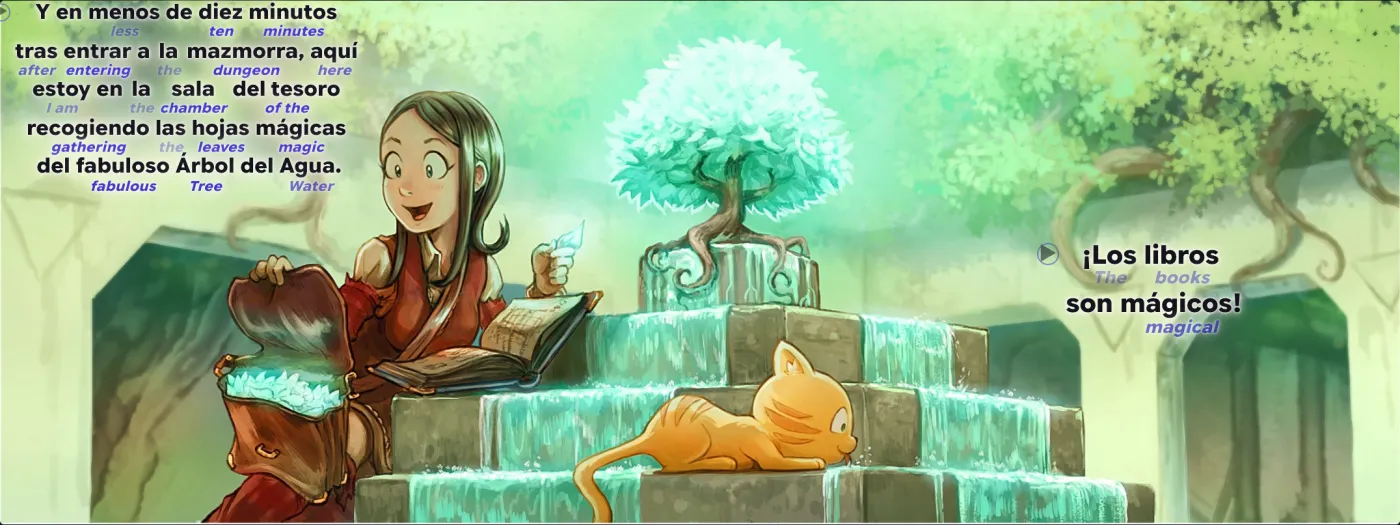
Slide toward fewer glosses and most of them go: the common words (diez, minutos, aquí) are the first to drop out, and mazmorra (dungeon) and recogiendo (gathering) are among the last to stay. A word that comes back fades sooner each time it does, and episode 26 has 8 lines that use libro.
The tab also has Mini Fantasy Theater, Revoy’s one-page strips (CC BY-SA 4.0), in English, Spanish, French and German. A one-page strip is about the smallest complete story there is, which makes it a good first read on a busy day.
Comics are included on the free plan. Switch them on under Account → Personalization → “Comics tab”. Glossa credits David Revoy and the translators of each episode; the comic itself is his, and his site is the place to support him.
Free for 2 books and 10 pages of reading.